From Burgundy Abbeys to the Arizona Desert: The Surprisingly Old Roots of New World Wine

Updated: Jun 27
Huge medieval history geek here. 👋 I'm the person at dinner who gets unreasonably excited when the conversation turns to siege warfare and moat-building. (But that never happens. 😞) So when I tell you that the deep-rooted connection between European winemaking and what we're doing at Skyhaven genuinely thrills me, I mean it in the most unhinged, enthusiastic way possible. The story of how wine traveled from monastery gardens in Burgundy to our fields here in Willcox is, at least for me, one of the best stories there is.
At Skyhaven, we constantly talk about Rhône and Bordeaux varietals. We talk about where our grapes come from and why we chose them. What we don't always get to explain — what I really want to tell you — is the centuries of history, tradition, and passionate human argument that sits behind all of it. The connection between an 11th-century French abbey and a high-desert Arizona vineyard is real, and it fills me with a kind of joy I didn't expect when we started planting vines.
So here it is. The full story. Grab a glass of wine, and pull up a chair.
In Europe, where you grow the grapes tells you what grapes you’re allowed to grow. In America, you grow the grapes first and figure out the rest later. 🤷
It started with monks
Before there were rules, there were monasteries. After the Roman Empire collapsed and took most of its agricultural knowledge with it, the Catholic Church — specifically the Benedictine and Cistercian monks — became the primary keepers of viticulture in Europe. They planted vineyards not just because they liked wine, but because wine was essential for the Eucharist. Every church needed a reliable supply.
What happened next is remarkable. Because the monks weren’t farming for profit or inheritance, they had something most farmers didn’t: time to pay attention. They kept meticulous notes. They observed which grape varieties did best in which soils. They noticed that Chardonnay thrived in one patch of Burgundy hillside but not another. They walled off their best vineyards — the famous French clos — to protect and study them. The Cistercians planted what would become Clos de Vougeot in Burgundy around 1115, and those same vineyard walls are still standing today.
A few things we owe to medieval monks: the identification of which grape varieties belong in which regions; the concept of terroir (the idea that soil and place shape flavor); detailed records of winemaking techniques spanning centuries; and the very idea that some vineyards produce something worth protecting. |
By the time the Renaissance arrived, European wine regions had accumulated nearly a thousand years of inherited knowledge. People knew what grew where. Reputations were established. And fakes were already a problem.

Then came the rules
When something is valuable enough to fake, regulation follows. By the early 1900s, winemakers in France were furious about fraudulent wines being sold under the names of famous regions. Imagine buying a bottle labeled “Burgundy” that had never seen a Burgundy hillside! The solution was the AOC system, established in France in 1935.
AOC stands for Appellation d’Origine Contrôlée — roughly “controlled designation of origin.” A specific set of rules a wine must follow to earn the name of its region: not just where the grapes grew, but which grapes, how vines are trained, the maximum volume of wine that can be produced per hectare of land, minimum alcohol levels, and sometimes even how the wine is made. France has 363 of these appellations. Italy followed with the DOC and stricter DOCG. Spain has the DO. The EU eventually wrapped them all into a common framework called the PDO, though most winemakers still use the older national names. |
OLD WORLD — EUROPE | NEW WORLD — USA |
The rulebook approach | The freedom approach |
|
|
That’s the old world in a nutshell: earned through time, preserved through rules. A bottle of Châteauneuf-du-Pape carries centuries of encoded meaning. You know exactly what you’re getting.
The same idea, a different continent
Here’s the part that may surprise: the American wine story began for exactly the same reason as the European one. Spanish missionaries moving north through Mexico in the 1600s and 1700s needed wine for the Mass, just as the monks of Burgundy had six hundred years before them. So they did what the monks did; they packed European vine cuttings and planted them wherever they settled.
What they found in the high desert valleys of the American Southwest was unexpected good news. The elevation, the dry heat, the dramatic swings between warm days and cool nights — it turned out to be genuinely excellent grape-growing country. The same qualities that make parts of Spain and southern France so well-suited to viticulture were sitting right here, largely undiscovered, in the American desert. The grapes didn’t just survive. They thrived.
The monks followed their faith and discovered great wine country. The missionaries did the same thing, three thousand miles away, six centuries later! 🤯
The wild west approach
The major difference is what happened after the planting. In Europe, centuries of accumulated knowledge eventually became law — specific grapes for specific regions, codified and protected. In America, there was no such history to draw on, and no patience for waiting centuries to write the rules. Settlers, farmers, and eventually serious winemakers just planted what seemed promising and got to work.
Prohibition dealt a near-fatal blow to American winemaking in 1920, wiping out decades of progress almost overnight. When the industry rebuilt itself from the 1960s onward, it did so with an American spirit: experiment freely, respect no boundaries, and let the wine make the argument for itself. Winemakers planted European varietals in places no one had tried before, and kept finding that the land had more to offer than anyone expected.
The American Viticultural Area system — the AVA — was created in 1980 to bring some geographic honesty to labeling without strangling that spirit of experimentation. An AVA tells you one thing: where the grapes came from. It says nothing about which grapes, how they’re grown, or how the wine is made. That’s intentional. America’s wine regions are still young, still discovering themselves, and the AVA system was designed to let that process happen.
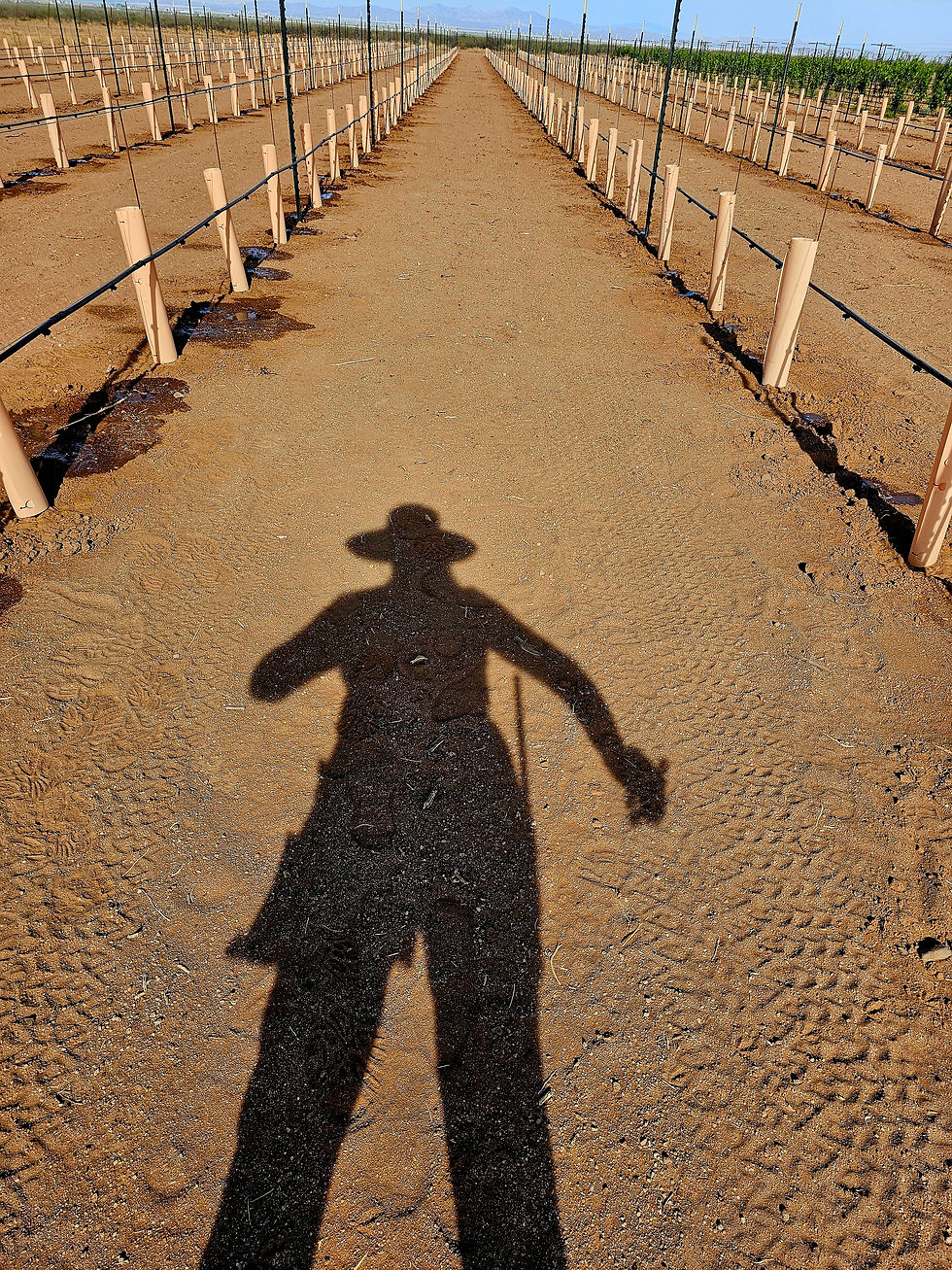
At Skyhaven in Willcox, Arizona, we grow Grenache Noir, Grenache Blanc, Syrah, Mourvèdre, Viognier, Roussanne, Cabernet Franc, and Petit Verdot — Rhône and Bordeaux grapes (plus some Italian & Spanish), side by side, in a high-desert valley at over 4,000 feet elevation. No European appellation would permit that combination under a single designation. They'd lose their mind! (And they do when we've visited French wineries and told them our story.) Our AVA simply says: this is Willcox. The rest is up to us.
Old world and new world — better together
It’s tempting to frame this as a competition — ancient European tradition vs. American frontier freedom. But that misses the real story. The European system gave the world a vocabulary for wine: the grape varieties, the understanding of terroir, the knowledge of which soils and climates produce what. We inherited all of that. Every vine in our fields traces its lineage back to those monastery gardens.
What America added is the freedom to take that vocabulary somewhere new — to plant Rhône grapes in an Arizona desert, to discover that the same qualities of elevation and temperature swing that make the southern Rhône valley extraordinary exist right here in the Sulfur Springs Valley, and to make something that couldn’t exist anywhere else.

The Benedictine monks at the famous Abbey of Cluny in Burgundy paid attention to their land and let it tell them what it wanted to grow. The missionaries who carried vine cuttings into the Southwest desert were doing the same thing. So are we. The rulebook is different. The instinct is identical.
That’s what every bottle from Skyhaven is — old world knowledge, new world ground, and a piece of land...um, and farmers....still figuring out what it can do. ⚔️🍷


Comments